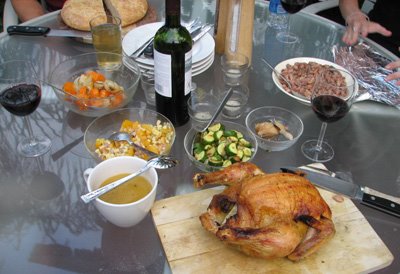
Wednesday, May 30, 2007

deliciously sound=soundly delicious

I'm only about three chapters in to Barbara Kingsolver's Animal, Vegetable, Miracle, and I'm hooked. I actually think I may have to put the book on hiatus for a few days (see below), but I didn't want to wait to share this quote:

"Food is the rare moral arena in which the ethical choice is generally the one more likely to make you groan with pleasure. Why resist that?"

Amen sister. One of these days, when I actually sit down and put my personal food philosophy into words, I'm guessing it will come remarkably close.

Oh, and speaking of groaning with pleasure (and also trying to figure out the complicated world of food, fuel, and the environment so I can get to the point where I eloquently define my personal food philosophy), I was delighted by the sheer brilliance of yet another solid event taking place at the Stone Brewery: the book & a beer club.

And of course, I'm even more delighted at the first book selected, as this may finally get me to pick up the book I've pledged to read for a year but haven't actually opened the cover of (although to my defense I've read two exerpts - here and, in print, here -and pretty much know the plot, moral undertones, and conclusions by heart).

Mmm. I can't think of a more pleasurable Monday evening than one spent in a gorgeous garden, sipping on a pint of Stone Vanilla Smoked Porter while contemplating how we eat. Here's to Michael Pollan for inspiring and Greg Koch for making it happen.

Thursday, May 24, 2007

Morning Commute Musings

Hm. sorry for this rant--sometimes a 45 minute bus ride makes you think, especially when you forgot a book to read...

Eating is one of the most sensual acts we do. We smell a food’s aromas, are enticed by its appearance, feel its textures, taste its sweetness, sometimes even hear it sizzling on the grill. Yet a lot of times we forget this--forget to experience the pleasure of biting into a just-picked apple, of sinking our teeth into a carefully roasted loin, or letting a thick spoonful of ice cream dissolve on our tongue. And the one reason I can think of that we forget to pause and enjoy what we're eating is that we've lost a connection with our food. Eating locally, I'm convinced, not only restores that connection, but allows us to truly enjoy what we're eating to the fullest extent.

Yet if there’s one thought I wish I could pound into my readers heads it’s this: eating local is not a challenge, it is a pleasure.


And I say this because I feel like the general sentiment regarding eating locally grown, purveyed, and produced food is along the lines of: sure it’s good in theory, but requires a considerable amount of effort in practice. Part of this stems from how we hear about these efforts—as many of the stories about eating locally frame the topic with a certain amount of time. James and Alisa, of 100milediet.org undertook a strictly local diet for a year. Others have followed suit with local food challenges that have lasted a week or a month (see, for example, Pennywise Eat Local Challenge).


Just a caveat before I continue--I’m a bit torn about writing a blog post about why eating locally shouldn’t be viewed as a challenge, because there are a lot of people out there who have undertaken some sort of local food challenge--pledging to eat locally for x amount of days--and I fully support their efforts. The reason I’m writing this is not to convince other people not to do this; it is to convince those of us who might not be interested in a challenge that it’s still a good idea to eat at least something, some time, locally. So here we go:


The thought of switching to an entirely local diet for a certain period of time is daunting. It requires a considerable amount of research—finding local farmers, producers, and businesses that roast, brew, assemble, and bake locally. It requires limiting your diet—because even the most bountiful of areas don’t have someone making/growing every type of food product. And it often involves sacrificing convenience, which little of us have the ability, or desire, to do. Again, this is not to say that it can't be done--I just don't think it's reasonable for the majority of people.


I guess my feelings on eating locally sit right up there with my personal feelings on vegetarianism or veganism, or on dieting in general: while there are many out there who are strictly adhering, I've never felt it's something I needed to try on an all-or-nothing basis. I don't think it's necessary to feel guilty about if you break the habit for a day, and not something that necessarily has to come with strict limits, rules, and restrictions--you can reap the benefits even if you only practice it loosely.

Again, I’m not saying undertaking a local food challenge is a bad thing for all of us. James and Alisa’s challenge needed to be done—it raised awareness about the issues involved and inspired countless others to start thinking locally. (And for inspiration I do recommend their website as well as their recent book: Plenty: One Man, One Woman and a Raucous Year of Eating Locally.) There are others for whom it is immensely practical--they live on a farm, or belong to a co-op, or raise their own food. And there are many benefits if you are already a socially conscious person who finds it easy to switch over to eating local-only food. It raises awareness, forces you to explore, and to step out of your comfort zone. But for the rest of us, making such a dramatic shift is just not that easy.


But don't let that deter you! I can’t help but fear that if eating locally is viewed merely as a challenge, the majority of people will simply choose never to undertake it, simply dismissing it as a big, seemingly insurmountable challenge that they have no interest in. And if you take a step back from things, on a global scale this is actually detrimental to the values and goals behind the local food movement! While some people eating 100% locally for one week, once, is a laudable achievement, it has far less of an impact than the majority of people eating somewhat locally all year round. But I’m distracting myself with the serious, when what I really hope to convey is the opposite. (I’ll save my tale of the planet, the greater health of the population, and the governmental policy for another day.)

The reason eating locally should be viewed as far from a challenge is because it is inherently enjoyable, even (or maybe especially) without a commitment. Tasting a tomato fresh off the vine, a strawberry that hasn't been bred for durability to be shipped 3000 miles, or a slab of bacon that has been cured in-house affords delight, discovery, and satisfaction. It doesn't matter whether you eat one local thing a month or 90% locally consistently--the pleasure is there every time you take a bite. And it is a pleasure everyone should experience.


Let’s look at my favorite moment of the week. Actually, the story starts on Sunday, so let me take you back a few days. Sunday evening, I headed to dinner at the Linkery, a slow-minded restaurant that focuses on serving "hand made cuisine" sourced from socially, environmentally, and health conscious purveyors (which also all happens to be delicious). Perusing the wine list, I noticed a meritage made in San Diego (from grapes grown in Baja), and decided to give it a whirl. I think there are at least 20 craft wineries in Southern California, but local wine is something I've not yet had the time to explore (partly because the local beer here is so amazing). So, I figured, why not start here, at one of the most purposefully-minded restaurants in the city.

With nothing to lose—my biggest disappointment could be that it was a sub-par wine, but I’d still enjoy drinking a locally-made beverage—I ordered it. Turns out the wine was delicious! It was a San Pasqual Meritage “Monte Soledad”. It was subtler than similar wines from Northern California, but had substantial body and just enough complexity to make each sip a pleasure. What a discovery!

Fast forward to yesterday, when I decided to look up the winery to see where I could get my hands on a bottle. Turns out the winery is not only located in San Diego, it is located in my neighborhood! I can't convey how excited I was to discover this. So on Monday, finding a list of independent liquor stores and wine shops that carry San Pasqual wines, I set out to one a few blocks away, and found, not one, but three San Pasqual wines (a merlot, cabernet, and chardonnay), all - get this - for $5 a bottle. The entire excursion—from a Google search to opening a bottle—took about 20 minutes, cost $15, yet afforded enormous delight! There's just something so rewarding in discovering something that you never before knew about, that you thoroughly enjoy, and that you realize also happens to be good for both the planet and your community.

I can’t emphasize enough how much you have to find this out for yourself. I encourage everyone who's reading this to seek out your own San Pasqual--maybe not tomorrow, or next week, but sometime this season. Keep your eyes open wherever you are, because I'm convinced local treasures abound.

In the mean time, here’s the delicious, and incidentally very much local meal I prepared in celebration of that bottle of wine:


Tortilla Espanola accompanied by San Pasqual “Cabrillo” Cabernet Sauvignon

Ingredients

2 tbsp. butter

1 lb. potatoes, cut into 1/2 inch dice (I used freshly dug local baby German Butter Ball potatoes)

½ onion, diced (I used a mix- ½ of a local Imperial Sweet onion and 2 local baby red onions)

2 strips bacon (not local-what was sitting in my fridge)

1 tomato (I used local heirloom from Carlsbad)

4 eggs (I used local free-range from Eben Hazer ranch)

¼ cup parmesan cheese (not local—the average grated stuff I had in the fridge)

Salt and pepper to taste


Directions:

Preheat broiler. In a cast iron skillet or other oven-safe skillet, melt 1 tbsp of butter over medium heat. Add potatoes, and cook, covered, for 10-20 minutes, until cooked through but not yet tender. Stir occasionally to flip potatoes. (If the potatoes get too brown, turn down the heat). Add the onions and cook 5 minutes longer, until potatoes are barely tender and onions are soft. If using cast iron skillet, turn off heat but keep above same burner (the cast iron will retain the heat--if using other skillet you may want to keep the heat on low). Add tomatoes, salt and pepper, and cover, so the mixture continues to cook from heat of skillet. In separate pan, cook bacon until crisp. Chop bacon into small pieces. In bowl, whisk together eggs, cheese, salt and pepper. Add bacon to egg mixture. Remove potato mixture from skillet. Melt remaining tbsp of butter over medium heat, and add egg mixture. Carefully scoop potato mixture into eggs so evenly distributed. Cook, covered, over medium heat for 5 minutes, until bottom is set but top is runny. Carefully lift the skillet into the broiler and broil, uncovered for 3-4 minutes, until top is golden brown. Let sit for 5 minutes. Slice into 4- 6 wedges and serve.

Monday, May 21, 2007

the world through Chris Jordan's eyes

It’s said a picture is worth a thousand words, but often it is a picture combined with words that provides the most resonating message. Last week, I came across the work of Chris Jordan, an artist who's major works focus on visually capturing our collective impact on the planet and ourselves.

Running the Numbers: An American Self-Portrait, is his most recent collection, focuses on capturing our culture through visual quantifications, with images depicting statistics such as the number of SUV's we drive, the number of cigarettes we smoke, and the number of plastic bottles we discard. While the photographs themselves are brilliant, often stunning works of design, it is the captions—the words that accompany each work—that make each image truly powerful. These words remind us that Jordan's works are not simply talented framings of inanimate objects, they are vivid explorations on our impact, through a resonating medium where the visual meets the literal.

When you're done browsing through his image galleries, be sure to glance at his artist's statement, which strikes a frightening chord:

"The pervasiveness of our consumerism holds a seductive kind of mob mentality. Collectively we are committing a vast and unsustainable act of taking, but we each are anonymous and no one is in charge or accountable for the consequences. I fear that in this process we are doing irreparable harm to our planet and to our individual spirits."

While our anonymity and our consumerist drive aren't going anywhere, perhaps we can begin to think twice before we swipe. Jordan is certainly pulling out all stops to encourage us to do so. He explains, "So my hope is that these photographs can serve as portals to a kind of cultural self-inquiry. It may not be the most comfortable terrain, but I have heard it said that in risking self-awareness, at least we know that we are awake."

Since coming across his website, I haven’t been able to get his starkly honest images—and their accompanying messages—out of my head. Intrigued by his explanation of Running the Numbers--"My only caveat about this series is that the prints must be seen in person to be experienced the way they are intended."--I hope I have the chance to see an actual installation. (Kids out on the east coast: Von Lintel Gallery, New York, June 14 to July 30. Kids out on the west: Armory Center for the Arts, Pasadena, CA, June 30-September). www.chrisjordan.com

Friday, May 11, 2007

Local Pleasures

I feel graced. For the past three or so weeks, I've found myself within two blocks of a farmers market not once, but twice a week, now that the summer-only market commenced in downtown San Diego (Thursdays, North end of Horton Plaza). This means that for the past few weeks I've found myself faced with an abundance of local goodies at a time during the week when I otherwise would have run out from the weekend before (Saturdays, Pacific Beach Drive and Mission Blvd.). I feel like a teenager who’s just gotten her first job and suddenly has a steady income of wealth, giddily unsure what to do with it all.

Needless to say, I've been spending many more hours in the kitchen, usually after I've spent all afternoon after Thursday’s lunch hour thinking about the bag of goodies I've treated myself to. Trust me, you can’t just steam a bunch of these farmers market veggies—this time a year everything is so gorgeous it would be a disservice to prepare them in anything less than a glorious, celebratory manner. Add to this the fact that I’m growing less and less fond of my neighbor next door (a Ralph's grocery—don’t get me started), I've been challenging myself to come up with dinner concoctions that rely as much as possible on the local bounty.

This week, as I strolled through the somewhat small, but nevertheless bustling, downtown market, I was drawn instantly to one thing—yellow squash. These medium sized beauties were positively glowing—not only were they a perfect golden yellow, their skin glistened, radiant. How could I not scoop up a handful? Down the table I eyed the broccoli, which I had been eyeing for weeks but passing up in favor of string beans, peas, and fava beans. But today felt like a broccoli day. And, broccoli and squash in hand, I was inspired—I had the perfect notion of how to properly celebrate the two. I quickly spun through the rest of the market, grabbing a luscious sweet onion here, and a few tender Carlsbad tomatoes there. With the garlic I had bought last Saturday, the Swiss chard begging to be picked in my garden, and the opened bottle of wine in my fridge, I knew I was all set.

On the bus ride home from work, I thought of my work ahead. Pasta primavera, the ultimate springtime dish, seemed a natural choice, but how to ensure I did it right? I decided to look up the classic recipe, the one that started it all, from Le Cirque in New York from the 1970’s. As it goes, Sirio Maccioni, owner and chef (at the time), faced with having to serve a large party with little notice, looked around his kitchen and, much the same way fresh produce can inspire anyone, came up with the dish, pasta with spring vegetables, or pasta primavera.

Maccioni’s version, while indeed a classic, is also incredibly time consuming, as it involves cooking each vegetable separately before combining them all with the pasta. Luckily, my favorite go-to source for recipes, Cook's Illustrated, reworked the dish some years back. Intent on preparing the Cook's version, I was about to head to the dreaded Ralph's for the two ingredients I needed—pasta and cream—when I couldn’t help but think the cream might be just a tad too harsh on this fine summer evening. And then it hit me—thanks to a mention of the possibility in Bon Appetit recently (in the form of a recipe for Brie, pasta, tomatoes, and olives from the May 07 issue)—I remembered I’d been dying to work Brie into a pasta dish.

Half an hour later, as I was stirring the Brie in with the tomatoes, I realized what I was making: Pasta Brie-mavera.

Pasta Brie-mavera

Serves 4

Ingredients:

4 tsps. butter

1 head broccoli, stalks removed, cut into tiny florets

1 medium yellow squash, halved and sliced

½ head swiss chard (about 6-8 medium-sized leaves), diced

1 medium sweet onion, diced

2 cloves garlic, diced

1 tbsp. fresh rosemary, diced

1 large or 2 medium vine tomatoes, diced

1/2 cup white wine

8 oz. Brie, rind removed

Salt and pepper to taste

¾ lb. fusilli, or other spiral-shaped pasta

Freshly grated Parmesan (for serving)

Directions:

Bring large pot of water to boil for the pasta.

In a large skillet, melt 1 tsp. butter over medium heat. Add broccoli and 2 tbsp. white wine. Sauté 5 minutes, until broccoli is cooked through but crisp. Remove broccoli from pan. Add melt 1 tsp. of butter, add chopped squash, and sauté 5 minutes. Remove squash from pan. Melt 1 tsp. of butter, add swiss chard, cook 2 minutes. Remove chard from pan. Melt remaining butter in pan, add onion. Sautee 5 minutes, until translucent. Add garlic and rosemary, sauté 30 seconds until fragrant. Add tomato, remaining white wine, and a dash of salt and pepper. Bring to a lively simmer. Cook 10 minutes. Remove from heat, stir in Brie, one chunk at a time, until cheese begins to melt. Cover, set aside.

When water boils, add pasta, cook according to package directions, 8-11 minutes.

When pasta is finished, reserve ½ cup cooking liquid. Drain pasta and return to pot. Stir tomato mixture until cheese is well-blended. Add vegetables and tomato mixture to pasta, blend to coat. Add cooking liquid, a little at a time, if needed to loosen sauce. Salt and pepper to taste.

Scoop generously into bowls. Top with freshly grated parmesan and serve warm.

Saturday, February 03, 2007

website

trying out a new format--blog on my own website. Might be writing more there than here.

duffystar.com

Wednesday, January 17, 2007

“Got Milk?” we all do. “Got Rich, Delicious and Affordable Milk?” now that's the question.

Here's one for you. I've posted previously about how anyone who enjoys wine should find that reason enough to start caring about the environment, but you have to figure, not everyone in the world likes wine. What about food though?

I challenge you thus: think about the most delicious thing you've ever eaten--whether that be an amazingly ripe strawberry or an absolutely perfect filet mignon--and hold that thought in your mind for a while until you start to drool.

Then, read this.

While you are reading, let go of that succulent thought for a minute, and let a drastically different, sub-par meal creep into your mind, perhaps even the meal you last ate. As you are reading, think about the difference between the two, between the delicious, wholesome bite screaming with flavor, and the bland, unstimulating, possibly-questionable average meal.

What makes that difference? Sure, if you're comparing McDonald's to Filet Mignon, part of the difference is in the preparation, or at least the talent of the cook who made your meal. But most of that difference doesn't involve talent or skill at all. Even the most talented chefs in the world couldn't shape a McDonald's burger into anything much better than a McDonald's burger (nor would many desire to even try).

The difference is in the quality, and the reason for the difference in quality is the land. The land on which our food was grown or raised on and the way that it was grown/raised plays an enormous part in what it ends up tasting like. It also plays an enormous part in how sustainable individual farming practices are, although when our stomachs are growling that's not always the first thing that comes to mind.

What hopefully does come to mind, however, is that delicious, mouthwatering bite you were thinking about minutes ago, and my hope is that after you read what Dan Barber has to say (which was published as an op-ed in the New York Times earlier this week), you too will want to seek out the sustainable, mindfully raised, and flavorful foods rather than the mass-produced, factory-farmed, by-product-causing bland ones.

Yes, all of this may be about another reason why we need to care about the Earth, but it's also about a gratifying and delicious decision we're able to make each time we sit down to a meal. And that's just the point--sometimes the best thing we can do for ourselves is the best thing we can do for the world.


Well go on. Here are two resources to help you find bursting-with-flavor sustainably-raised produce in your area:

http://www.sustainabletable.org/

http://www.localharvest.org/

Friday, November 10, 2006

Thinking Green, in more ways than one


Last week, Nicholas Stern, former chief economist of the world bank, unveiled The Stern Report, an extensive analysis of the "cost" of global warming. The report takes a major step in the consideration of global warming, because it casts environmental issues in a light usually far removed from the environment: economics.

Yes, the Stern Report concluded, even staunch economists need be concerned about global warming because it will prove to be detrimental to our thriving economy (among other things). David Suzuki sums up the report concisely and resonatingly here.

(Got some time to kill? Download the complete 700-page report here.)

Tuesday, November 07, 2006

election day blues

As I stared down at my ballot this morning, slowly filling in the bubbles, I found myself quite contemplative. Once a year we're asked to think about the future, to make our individual voices anonymously heard, to select the individuals we want shaping our lives and the rules we live by. Yet sometimes politics seems so trivial--just think of the enormous amounts of energy, dollars, and resources spent each year to fuel political rivalries, fight fierce campaign battles, and promote bureaucratic propositions to funnel funding here or redirect tax revenue there.

Undoubtedly, I care about a good number of these political fights, some more passionately than others. Yet sometimes I wish we could just send each other messages without subversive undertones, base our actions on honesty rather than strategy, and focus our efforts on putting forth messages that actually benefit the common good.

Serendipitously, after returning home from the polls I came across a message so perfect I had to smile.

This mosaic apparently graces the entrance to a G train platform at a subway stop in Brooklyn:

Monday, September 11, 2006

Slow = 10 wines, 8 courses, 4 hours, and 1 happy diner

I haven’t posted to this blog in a while—I’ve been tied up with a few other projects and have been trying to take advantage of as many long evenings as possible before the sun starts setting earlier and earlier. There has been a lot that I’ve had my eye on in the past few weeks that I do want to write about; however today my priority is once again food.

I’ve been reading Slow Food: The Case for Taste, by Carlo Petrini, the founder of the Slow Food movement in Italy, and stumbled upon a delicious passage in chapter one that I think deserves sharing; if for nothing else, the passage again reminds us of the delicate connection between food and the environment. The context of the quote is Petrini’s description of the evolution of his organization and the thoughts and objectives of its members:

“By now the overall intent and approach were well defined. The ‘arcigoloso’* was an alert consumer, filled with curiosity, who wanted to take part first hand and to learn; he or she frequented restaurants and wine cellars; shunned pseudoscientific presumptuousness and black-and-white pronouncements, respected the work of those who chose the food trades, and displayed tolerance. She participated in initiatives like the Fraternal Tables that undertake to bring aid to various parts of the world afflicted with war, famine, and poverty, because in the new millennium those who have grown, along with Arcigola Slow Food, to relish eating require two essential qualities: generosity and respect for the human environment. She is jovial and optimistic by nature and is able to communicate these qualities in daily life, and especially at meals: you can’t enjoy good food and be greedy and ungenerous at the same time. Nor can you be a gourmet and not care about the environment: people like that wind up as dupes, exalting food and cooking that are clever but phoney”

[* Arcigoloso is the name given by Petrini to members of the Arcigola Slow Food. According to Petrini, “The name Arcigola is a play on words: “Arci” comes from ARCI [Associazone Ricreative Culturale Italiana] but is also a prefix meaning “arch-,” and many founding members had a connection to the magazine La Gola (“la gola”=appetite for, enjoyment of, food; gluttony), so “Arcigola” suggests “ARCI-Gola,” and also “archappetite” or “archgluttony”]

Reading this description, I couldn’t help but instantly decide that this was exactly how each meal should be approached—with curiosity, respect, generosity, and awareness (for taste, but also for how food is prepared, where it comes from, and who you are enjoying it with). Luckily, I soon had a delightful opportunity to put this attitude to the test.

I had a dining experience last night that not only far surpassed every other experience I’ve ever had (combined) in being absolutely phenomenal, but that also embodied all of the wonderful aims of the slow food movement.

Partly in celebration of my parents visiting and partly because I have been pressured to go for some time, I made a reservation for four at Nine-Ten restaurant in La Jolla. I’ve written about my experience with wine at Nine-Ten previously, however no previous experience could compare to what I am about to describe.

The chef’s at Nine Ten produce what can only be described as elegant and ambrosic combinations of flavors, textures, and visual delights. Their menu emphasizes local produce from local farms, which changes often depending on availability of ingredients. The kitchen staff, I’ve been told, rotates taking daily trips to local farms for ingredients, such as Chino Farms in Rancho Santa Fe (who don’t have a website but their address is listed at the end of this post for San Diego-area readers), ensuring that only the freshest ingredients hit the table. What this means is that the food is not only fresh, but also mouthwateringly delicious. The chefs, inspired to tailor the menu to what is in season, are constantly working to create new dishes with more sensational tastes.

We knew the evening started out well when the Sommelier stopped by our table shortly after we had just taken our first taste from the bottle of wine we ordered, a 2002 Grenache from France. “That is absolutely one of my favorite wines,” he eagerly conveyed, “and you are very lucky as it’s the last bottle we have.” Shortly after, while we were savoring our luck and the tasty Grenache, a waiter came by with a complementary “taster” from the chef: a tidy puff pastry filled with creamy crab and potato filling. Little did we know this was only the beginning of an eight-course, four-hour event.

Next we found ourselves sitting in front of two dishes we had selected from the “First Course” menu. I managed to convince the table to try the fig and truffle salad, which consisted of marinated fresh figs from Chino Farms layered with delicately shaved truffle slices, set atop equally thin pancetta and drizzled with truffle oil. Any hesitation on the table’s part when ordering—“figs, really?”—was instantly forgotten when we all took our first bite. The combination of flavors (salty and sweet, woody and fruity) and textures (succulently soft, slightly crunchy, deliciously tender) made you want to savor each bite for as long as possible. This dish was paired with a pinot noir that seemed instantly refreshing and somehow complemented each of the distinct tastes on the dish. It was going to be hard to forget this dish as the dinner progressed.

The other dish on the table was a baby beet salad with roasted baby carrots, toasted walnuts, candied baby fennel, arugla, and champagne vinaigrette. While I again had had to do some persuading to order the beets, this time when the dish arrived, it wasn’t able to win over the anti-beet contingent at the table. Beets have a pretty strong flavor, and while the walnuts and champagne vinaigrette complemented them perfectly, they still tasted like beets. However, the table was pretty happy with the wine pairing with this dish: a sparkling chardonnay from France. Personally, I enjoyed the beets, and was also happy to learn a bit from the sommelier about what makes a champagne a champagne (grapes from the Champagne region). Of course, we were all pleased to find that even not-technically-champagne sparkling wines still were full of bubbly delight.

As we bottomed-up our champagne glasses of non-champagne, the kitchen was preparing our next round of deliciousness, again two dishes we had selected from the menu. These, the “Second Course” dishes, were what our waitress claimed were some of the “hidden gems” on the menu—smaller-sized dishes with intense flavors and combination of tastes. She was certainly right.

We first tasted the Maine scallops, which were served pan seared atop a slice of comfit roma tomato which was in turn atop a thin shaving of baby squash, all topped with piccolo basil, cherry tomato relish, and garnished with a black olive puree. I can only describe the precise deliciousness by repeating the first words emitted upon taking the first bite. “Oh my god this is the best thing I ever tasted,” a statement which could only be followed by murmurs of agreement from full mouths, as we all savored the delicate scallop and tart tomato balanced atop our tongues. This dish was accompanied by a chardonnay, which our sommelier explained was paired to combat the slightly bitterness of the tomatoes with the buttery creaminess of the wine.

The chardonnay itself was not to be ignored—we were served a 2003 Molnar Family Poseidon’s Vineyard Chardonnay, which was particularly described to us in terms of the environment in which it was created. The vineyard itself is named to pay homage to the god of earthquakes for creating the Mayacamas mountain range, which provides the terrain for these grapes. However, the wine itself is not only a product of the Napa land on which the grapes were grown; it is specifically aged in Hungarian Oak Barrels crafted in Budapest by the Molnar family and shipped to California to give the wines a distinct flavor. The flavor is further made complex by removing a small percentage of the wine from the Oak to store it in steel, providing just a hint of citrus and acidity. Who knew so many elements could play a part of one delicious wine?

We only reluctantly moved on to the next dish (after sipping the rest of the chardonnay and contemplating how many scallops we could have eaten if given the option). Yet, of course the next dish turned out to be equally as tasty as its predecessors.

Our taste buds took a dramatic turn from the light buttery flavor of the scallops to the deep, woodsy flavor of house made paperdelle pasta with wild mushrooms and veal stock, tossed with fresh herbs and the natural mushroom au jus. Our sommelier decided not to provide us with a wine for this dish, as he promised it would pair perfectly with the Grenache that was already on our table. While others noted how right the sommelier was, I kept quiet, contemplating the wonderfully complex mushroom flavors in my mouth, trying to pinpoint how exactly I would describe them. (I couldn’t). I can only attempt to convey their sweet earthiness, with the savoriness or umami that isn’t quite describable with words.

After lingering over the last tastes of the wild mushrooms as they dissolved in my mouth, we took a moment to revel in how amazing the meal had been so far. Thinking back on the five dishes we had been served, I realized the sweet figs, delicate scallops, and savory mushroom pasta had been far and away the most amazing and intense flavors I had ever tasted. I smiled at this, and realized it was exactly how a meal should be—the discovery of absolutely mind-blowing tastes, the delight of novel combinations of foods, and the unhurried pace of a multi-course meal where nothing seems more important than the present.

Once we had been left to contemplate our experience so far, our waiters returned bearing more dishes, and set beside us another duo of artistically adorned plates. The first consisted of a line drawn across the plate dotted with tiny agnolotti—small crescent-shaped pastas filled with a creamy cheese and chives. Each agnolotti sat atop a sliver of bell pepper or a baby artichoke heart, and was accompanied by an absolutely astounding parmesan foam. The dish, we soon discovered, was created by the chef mere nights before, when a fury of creative genius kept him in the kitchen until one a.m., until he was able to satisfy himself with an approximation of perfection. Due to this, our sommelier did not have a wine to provide, as he felt he hadn’t yet had the chance to evaluate the complexities of the dish in light to find its ideal partner. (A process which I decided would be a phenomenal challenge to undertake).

Beside the agnolotti dish was a bowl of Truffle Risotto with truffle oil, with scattered slivered truffles delicately balancing on top of the creamy starch. The risotto was perfect—a harmonious combination of silky sauce wrapped around firm granules of rice to produce a texture and consistency I had never fully experienced. This was risotto perfected. Our attention, however, was briefly drawn away from the risotto itself to concentrate on the slivers of truffles adorning the plate, as it seemed we might not have the opportunity to eat truffles again for decades. The crisp slivers melted as they touched your tongue, providing a hint of woodiness along with a shiver of delight.

We took our time savoring these two dishes, with the disappointing awareness that we were beginning to feel the faintest hint of fullness. However, we were not to be deterred, for our entrées were about to arrive.

Before our plates were delivered to the table, we were delighted to receive a surprise visit from the sommelier. Noting that our main entrées ranged from delicate halibut to domineering steak, he approached our table with four different wine bottles in hand. Proceeding to pour each of us a different glass of wine, we found our experience had now become the best of both worlds: we had obtained the camaraderie of sharing a bottle, but need not compromise by drinking a wine that did not pair perfectly with our entrée. Even my father, who expected the heavy-ish Grenache to pair perfectly with his New York steak, was provided a heavy cabernet that performed even better.

My Hudson Valley duck breast arrived atop grilled escarole and lavishly draped with almond foam. To its side a row of baby turnips and Thumbelina carrots swam in a stream of deep purple bing cherry & basil puree. I was poured a 2002 Oregon pinot noir, which as promised, served as a light accompaniment to the dark breast meat. The surprise part of my meal, however, was the delicate turnips, which seemed to have a hint of vanilla and provided a refreshing palate cleanser between bites (this, I discovered, was particularly helpful when demanding a forkful of everyone else's meal).

Across from me, a generous portion of roasted northern halibut, draped with Chino corn, and chanterelle mushrooms was served to my mother. The plate was shared with Yukon gold potatoes, and a sweeping pour of turmeric corn puree rimmed with balsamic glaze. This was paired with 2005 sauvignon blanc from France; 2005, we were told, being an exceptional year for sauvignon blancs in France, producing wines of a caliber not seen in the region since the 1960’s.

Next might have been my favorite looking plate of the night, with a massive New York steak of corn and grass-fed beef draped with a mixture of pickled corn and onions, towering over the most delicate looking fingerling potatoes, which were lined up in a row like tiny soldiers marching across the plate. Atop what appeared to be the lead soldier was perched the most petite vegetable I have seen—an infant potato no larger than a pinky fingernail. It was one of those presentations you feel guilty for touching, and there was something about the dichotomy of giant and midget on the same plate made you want to smile. So did the description of the cabernet (80%) merlot (20%) blend that was paired with this dish, which was described as being both “fatty” and “chewy,” which perfectly mirrored the qualities of the beef.

Finally, next to me was the second steak dish on the menu, two thick slices of a Prime Flat-iron set atop caramelized torpedo onions and a cipollini onion puree with confit garlic. This shared the plate with haricot vert (green beans), red wine sauce, and a potato accompaniment that was as far opposite from the previous dish as the definition of potato could stretch: a single, enormous cut of a perfectly crisp Yukon potato. Once again, the creative dichotomy made me smile. This steak was also paired with a cabernet, from a vineyard in an area of Napa that I believe the sommelier claimed was soon to have it’s own appellation (actually American Viticultural Area, or AVA) defined.

This, I again pause over, as the concept of “appellation” links what we consume to its origins. The word (originating from the French) implies that different regions produce different grapes (or cheeses, or other food products) due to the different conditions of the soil, climate, and elevation. The idea stems back to the 15th century, and has over the course of time been used to link the quality of the grapes to the conditions of the land. In the US, new AVA’s are defined when it can be proven that within the boundaries of a certain area, there exists a unique set of conditions that yield a particular grape. Serious wine lovers (of which I don’t yet claim to be) use appellations as one of the major criteria when purchasing wine, as often it is known that the particular characteristics of an area will yield a great grape.

But back to our delicious food. Most of the time, you feel your meal is complete after you put as much of a dent as you can into your entrée. Tonight, however, this was not the case. After expressing to each other how perfectly we felt our wines accompanied our dishes, and after relishing not only the array of textures and flavors on our own dishes but sneaking tastes of everyone else’s, we set our forks and knives down, although not for good.

Soon two more dishes appeared from the kitchen, this time far more petite than the previous course, offering us just a taste of some of the potent flavors we had missed from the menu. This, I discovered, was a brilliant move, allowing us to experience two additional intense bursts of flavor in just a few additional bites.

We first sunk our forks into a port wine braised short rib that pulled apart on contact, set atop more wild mushrooms, and surrounded by white truffle emulsion and herb oil, topped with deliciously brilliant potato foam. If the short ribs pulled apart on contact, it was only to have the bite dissolve in your mouth upon entering, literally causing you to sit back and shut your eyes for a moment of contemplation before swallowing. The potato foam challenged the delightful parmesan foam that was served earlier in the evening, pulling a close second in terms of the delight of tasting flavor removed from it's expected consistency.

The second dish caused a similar reaction, with tender smoked and braised pork belly presented next to polenta made from heirloom corn (from Anson Mills), topped with , black eyed peas, and slivers of okra. Anson Mills, I just have to note, is a small company dedicated to “the preservation of Southern heirloom corn, rice and wheat—and the artisan milling practices associated with them.” Heirloom varieties are heralded by the slow food movement, becoming increasingly important as farms merge with corporations, and varieties of crops are being bred for resistance, shelf life, and profit margins. Any kitchen that goes out of its way to incorporate heirloom varieties on its menu certainly gains my support.

After finishing these two delectable bonuses, we received a much-anticipated visit from sous-chef Chris Bleidorn. Grinning as he sat down next to us, he need only read our faces to find how we liked our food. Of course, he wasn’t done serving us either. With a bit of hesitation, we agreed to take a look at the dessert menu, and with no hesitation, decided we needed not one, but two desserts (after all, we had tasted at least two options of every other course, why should we stop now?). However, before desert was delivered, our waitress came over with a cheese course, which, Chris managed to slide in. With two tasty cheeses accompanied by candied walnuts and homemade herb crackers. we now felt like kings, (perhaps Bacchus?). Finally, when we felt we might not be able to eat another bite, our dessert was delivered, and our eyes lit up at the elegant cheesecake topped with champagne grapes and the not-often-seen beignets served with lemon gelato, candied lemons and candied mint. Speaking of Bacchus, I distinctly noted that the Grenache, which had managed to linger in our glasses, having been ignored throughout the other courses, seemed to now take on a hint of the qualities of port—strong and slightly sweet, the perfect, albeit unintentional, accompaniment to our final bites of this absolutely unrivaled meal.


Chris, I honestly don’t know what to say, not only in terms of our gratitude for this experience, but also in terms of your talent, creativity, and, in terms of that fig salad, genius. Don’t be surprised that we're already looking for the next opportunity to swing by…

For those in the San Diego area, Chino Farms is open to the public and can be found at:

Chino Farms Vegetable Stand
6123 Calzada del Bosque
Rancho Santa Fe (off Via de la Valle, S6), CA

The hours I was able to find were as follows, although without having yet made a visit there myself, I can't confirm them:
Fall/Winter: Tuesday-Saturday 10-4; Sunday 10-1
Spring/Summer: Tuesday-Saturday 10-5.

One last note: I'm pretty sure I'm missing a few details here and there, especially in terms of wines, which I hope to fill in with the help from my table-mates. Until then, I apologize for any slight inaccuracies, but I wanted to share this experience as quickly as I could.

Thursday, August 17, 2006

What's this all about anyway?

In case anyone happens to wander over here from muzzle of bees (where I snuck in a guest blog post), I thought I’d whip up a quick note as an introduction to this blog.

When I was a kid, I remember learning about all sorts of environmental issues in school. I did a project on solar power, and another one on why we shouldn’t litter. I think it’s safe to say that we all grew up being taught about the environment and why polluting it was bad. But fast forward 20 years (give or take), and how many of us are actually still thinking about those issues? I, for one, was not, and I know a good number of my friends weren’t either. Sure, I wouldn’t toss trash from my car, wouldn’t litter on camping trips, or leave anything behind when packing up from a day on the beach; I wouldn’t intentionally harm the environment but certainly wasn’t doing anything proactive for it either.

And then I thought about it one day and wondered, would it really be that painful to start actually caring? So I decided to give it a stab, and decided to write about what I was doing along the way, and you know what? It isn’t that hard at all.

So if you’re just arriving here, here are a few quick and painless ways I’ve found to get started:

1. Reuse your grocery bags. I found some cloth bags I’m a fan of but even reusing the plastic bags you have laying around your house is a start.
2. Switch out some of your lightbulbs to Compact Florescent Bulbs and save some energy.
3. Try staying away from traditional cleaning products and instead use non-toxic baking soda and vinegar to get the job done.
4. Try eating local at least once a week, and help cut down on the fuel used to transport food.
5. Go see an Inconvenient Truth (it will scare you into doing at least one of the above)

My hope is that anyone who reads this blog might just be up for giving one (or more) of these a try. If you're just arriving and need more justification, I hope you'll explore some past posts, which try to give a few good arguments in favor of saving this planet of ours. And I promise--I'm not asking anyone to turn into a treehugger or a vegan (not that there's anything wrong with that). I've just come to realize that a little bit of thought here, a tiny bit of effort there is something many of us can afford. And take it from someone who just started caring--once you start picking up on these habits they don't seem out of the ordinary at all.

Thursday, August 10, 2006

Slow Food Sunday

I can safely say that there have been times when I have literally cringed at the thought of having to order from a fast food restaurant. Now, it's not that I haven't dined at each of these fine chain establishments over the course of my lifetime, and it's not that I find myself "above" them at all, I just truly dislike the experience (not to mention the taste). There is something about the plastic sterile atmosphere, the grease seeping through the paper bag as you steal fries out of it on the drive home, and formulaic way the food is prepared that just doesn't appeal to me. This extends to the "made to order" fast food chains as well, not just the chains with cute cartoony mascots and heat lamps on 18 hours of the day. I actively avoid Subway, won't set foot inside of FatBurger, and can count on one hand the times I've sat at an In N' Out drive thru.

This of course, can be a point of contention in our apartment. I live with someone who 1. has purchased every item on the Wendy's $1 menu at once and attempted to eat it all in one sitting, 2. has performed the McDonalds' menu song live on stage and continues to know it by heart, and 3. i'm pretty sure still carries Subway club stamps around in his wallet (the program ended years ago). So from time to time this means that we end up in situations like last week, where one of us ran out to Chipotle for a take-out burrito while the other ran to the store to get ingredients to make homemade vegetable soup.

Luckily, despite these few instances where our taste buds butt heads, I think I've slowly been able to triumph over the fast food giants by proving that "anything they can do I can do better." This of course might seem like a ridiculous challenge to some, but I see it as a win-win situation: you don't have to eat carelessly slapped together hamburgers whose origins are so questionable you don't even ask; and you get to eat deliciously tasty stuff. I've made buffalo wings from scratch for the superbowl, deep fried homemade falafel just to see if I could do it, slow cooked a pork butt for highly-touted pulled pork sandwiches, grilled a whole chicken over a beer can (because why not?), made imitation Gus Burgers with veggie patties (a Charlottesville institution, which consists of a cheeseburger topped with a fried egg, featured in the annual Gus Burger eating contest) and whipped up countless dips, munchies and hors d'ouvres. I'd like to claim I am winning without contention.

So, liking to think that I am fearless in the kitchen and having a partner who is willing to try anything I concoct (to a point--Zucchini and Heirloom Tomatoes apparently are crossing the line), I decided to initiate the "Slow Food Sunday." What, you may ask, is a Slow Food Sunday? It's simple-you spend a Sunday afternoon preparing a meal entirely from scratch, using minimally-processed ingredients and local and seasonal food when possible, spend your time cooking consciously, aware of where your food was grown and how it is being prepared, and sit down with some friends (and maybe a good bottle of wine) for a quality meal. The term "Slow Food" comes from the slow food movement, which was started in Italy by Carlo Petrini in 1980's in protest to a McDonalds opening up. The principles of the slow food movement are those that I wholeheartedly embrace, and which without even realizing it, I have been supporting all along with my aversion to fast food.


The Slow Food concept "opposes the standardization of taste [ahem, fast food chains], defends the need for consumer information [knowing where your food comes from], protects cultural identities tied to food and gastronomic traditions [e.g. the importance of the family meal], safeguards foods and cultivation and processing techniques inherited from tradition [which does not include deep-frying large batches of potatoes] and defend domestic and wild animal and vegetable species [those delicious heirloom tomatoes, for example]." In essence the slow food movement encourages us to take the time to think about our food, where it came from, what it's value is, how it was traditionally used throughout history, and to savor its delectable taste.

So how is the Slow Food movement related to the environment? Quite simply actually, because if you reduce food to the most basic level, our vegetables, fruits, and grains are all grown from the earth, and the meats we eat all come from animals who feed off these grains. That we need to grow or raise (or I guess hunt) what we want to eat is a fact, yet often a conveniently forgotten one. Food, over the past century, has become slowly detached from the environment in which its grown, to the extent that we routinely come home from the grocery store with bags of chips, loaves of bread, or boxes of cereal containing grains that, despite the fact that we are going to easily devour these foods, we have no idea where they were grown or perhaps more importantly, how. While some of us might prefer the simplicity of picking up a convenient snack and not caring about its origins, the truth of the matter is, without adequate growing conditions, there would be no food for us to eat. It benefits us all to realize that if the planet's environment starts to degrade, the quality (and safety) of our food will begin to degrade as well.

The Slow Food Movement, according to its mission, "links pleasure and food with awareness and responsibility." It seeks to connect eating and tasting with the food itself-its history, it's cultures and traditions, the environment that it was grown in, the path that it took to arrive on your plate. When you think of food in terms of all of these elements, not all foods are equal. Some foods are grown more humanely than others, some are grown with a lighter footprint on the environment or with less pesticides, and some are bred for superior taste, texture, or color. What the slow food movement strives to point out is that those foods that are grown by local farmers on smaller farms not only have a reduced impact on the environment, they taste better too.

Just as with any other product you buy, as a consumer you have choices. When it comes to food, we shouldn't ignore the toll on the environment that the production of food takes. Food grown in a local garden takes only the nutrients of the soil, a water supply, and the sun's rays to be grown, ripen, and be eaten. Food that travels farther than garden to mouth needs an increasing amount of resources the farther it has to travel. Add in processing, packaging, and international transport and those resources start to add up. Some great statistics in support of eating local food can be found here. The slow food website reminds us that:

"Possibly, many are unaware of the concept of incorporated energy or, in other words, the baggage of 'hidden' energy that each and every product brings with it, derived from the use of fossil fuels required for its production, transportation, preservation, packaging and waste disposal."

By choosing foods that are local, organically grown, and minimally processed,
proponents of the slow food movement are naturally part of the environmental movement
as well.

So with this in mind, I propose to you the concept of the Slow Food Sunday. Spend just one day a week actually thinking about your food, where it came from, and how amazingly delicious it tastes when you prepare it yourself. This past Sunday was my first Slow Food Sunday, and I'd like to say it went off without a hitch. It did take a day of advance planning, as my local farmer's market comes through on Saturday mornings and I had to be sure to buy all I needed (although I admit there were a few purchases at a local grocery for some last minute ingredients).


After some consideration and some perusing at the market, here's what I came up with for a menu:

Homemade Rustic White Bread with Roasted Garlic
Heirloom Tomato and Grilled Corn salsa
Slow Cooked Tuscan-Style Pinto Beans with Sage
Sauteed Baby Zucchini
Baked Carrots and Baby Onions
Lemon Roasted Free-Range Chicken

A little hint of decadence, a little more time required than usual, but all in all an exercise in consciousness I wholeheartedly recommend, that in the end is an absolute delight to the senses.

Want to get started?
Sustainable Table has great resources to find out what foods are available locally in your area. So does the eat well guide, and FoodRoutes.org has a pretty comprehensive listing of local farms, farmer's markets, and farm stands throughout the US. So what are you waiting for? Next Sunday is only 3 days away!

Monday, August 07, 2006

Rockstars of the [last] week

Last week, thanks to SubPop Records, I decided to declare a whole group of bands as the Rockstars of the Week (I just didn't get around to writing about it until now). My favorites among this group include Band of Horses, Iron & Wine, Jesus and Mary Chain, Mark Lanegan, the Postal Service, The Shins, Stars, and Wolf Parade, but the full list of SupPop eco-heroes can be found here.


"Green" SubPop artists (clockwise from top left): The Shins, Iron & Wine, Band of Horses, Mark Lanegan, Wolf Parade, Postal Service


The reason for this recognition? As of last Monday, SubPop announced that it was “going green.” Specifically, the company has decided to offset 100% its energy use through the Green Tags program offered by the Bonneville Environmental Foundation. Through this program, consumers purchase green credits to offset their non-renewable energy usage, and the green credits in turn support renewable energy sources elsewhere in the country. The idea behind the program, and similar programs, is that you can support renewable energy even if it specifically is not available in your location.


I do have to note here, that ever since I heard about the idea of carbon offsetting, I’ve been admittedly skeptical as to the extent it actually helps the environment. I mean, it doesn’t actually reduce anyone’s energy usage, it just allows them to feel good about their energy consumption by spending money on environmentally friendly efforts. I’d compare it to a crotchety Mr. Burns-type character hurriedly dashing off a check to some bothersome visitor just to be able to say “there, see, I’m supporting your cause, now leave me alone to my opulent and lavish ways.” Buying your way out of a situation has never seemed like a legitimate option to me, if by spending money you find an excuse not to have to change your low-down ways.


However, not wanting to pass judgment without completely understanding the situation, I decided to do a bit of research and actually discover what the benefits of this complicated financial and ecological transaction actually are. The company that SubPop has chosen to buy “Green Tags” from is Bonneville Environmental Foundation, so I went to their website first to investigate, as well as to the website of Green-e, which is a certification bureau that monitors programs that sell green certificates.


The idea behind green certificates is not exactly straightforward and not the easiest to explain. For a legitimate explanation, I suggest going here. For a layman’s definition, keep reading, and I’ll do my best. I’ve actually found two explanations; the first is pretty straightforward and the second leans slightly towards favoring the program, I think. The straightforward explanation is that a green tag represents the difference in cost between producing renewable energy and the market value for energy. Because the government partially subsidizes traditional energy sources, and does not subsidize renewable energy, the cost of producing renewable energy exceeds that of non-renewable. The green tag represents the difference, and when traded, makes up the lack of funds to allow renewable energy to be created and sold at the market price (as my handy graph above illustrates). Thus the idea is the more green tags bought, the more renewable energy subsidized, and the more that can be created.


The slightly, well, polished explanation I found came from within the renewable energy industry, and claimed that renewable energy can be divided into two parts, the physical wattage and the benefits associated with it. The wattage is the part that actually creates energy, while the benefits include reduced carbon emissions and non-dependence on renewable resources. It’s as if you separated the physical value of a Christmas preset and the emotional value of receiving the present. According to the Bonneville Environmental Foundation, “Green Tags represent the environmental benefits that occur when clean, new renewable energy is substituted for power that is produced by burning fossil fuel.” By viewing it this way, and separating renewable energy into two valuable parts, you can treat them as distinct (albeit related) entities, allowing the energy part to create energy in one part of the country while selling the benefits part to someone elsewhere.


The difference in these two explanations is not that much, except that one is strictly economic while the other tries to make you feel better about paying money for something you can’t physically see. What both boil down to is that green tags are bought and sold to support renewable energy. This is a highly regulated practice, where one green tag is issued for every 1000kWh of electricity produced (that’s kilowatt hour, the standard energy measurement, which you can look up if you want an explanation). Green-e is one such regulatory agency that monitors the number of green tags per electricity, to ensure that the ratio is strictly at 1:1,000, or that there is not more than one green tag sold for every 1,000kWh.


The idea behind the Green-e program is that there are many locations where homes and businesses don’t have the option of renewable energy, because their local energy company doesn’t offer it. In these locations (or any location) consumers who would otherwise opt for renewable energy sources can choose to buy “Tradable Renewable Certificates” (TRC’s) as a way of “offsetting” their nonrenewable energy use. Offsetting essentially means that you purchase enough green certificates to balance out the amount of fossil fuels you personally use. This extends to as many applications as there are ways to use energy, from your monthly electricity bill to your daily commute to your annual family vacation where everyone climbs aboard a gas guzzling jet (which, I just learned, use about 5 gallons of fuel for every mile!). In SubPop’s case, they have chosen to offset all of the energy involved in the company’s operations.


The clutch detail that both shocked me and probably converted me into a supporter of green tags is discovering the statistic that (according to Green-e) only 2% of the electricity generated in the US comes from renewable resources. TWO Percent!!! Here we are lamenting the price of gas, worrying about the depletion of the earth’s resources, and we have only progressed far enough since inventing photovoltaic cells to allow 2% of our energy to come from solar, wind and other renewable sources? That statistic alone makes me want to support green certificate programs, as they provide hope that with more financial support the prevalence of renewable energy will spread.


So should you by green tags? That depends on how much you can afford to. In terms of ease and convenience, it couldn’t get any easier. In the words of Sub Pop president Jonethan Poneman:


“I was, quite frankly, shocked by how easy it is to support renewable energy. Green Tags are a simple way for anyone to choose wind energy, which, in turn, lowers dependence on burning fossils fuels for energy.”


However, I still adamantly maintain that being able to say you support a cause isn’t exactly the same as making lifestyle changes to support it. So I think if you’re going to buy energy certificates you also have to make a considerable effort to reduce your energy consumption as well. I actually think that a great way to make this work would be to model the structure of some of the international environmental treaties, which add another dimension to the practice of purchasing green credits. In many of these programs, including those set forth by the Kyoto protocols, developed nations are all allotted a specific allowance of emissions credit, which allow them to pollute only a specified amount. If the nation goes over this amount, they have to purchase “credits” from underdeveloped countries who are not polluting nearly as much, or who are practicing exemplary sustainable practices. The idea is to reduce overall emissions world wide. Applied on an individual scale, each household or business would get allotted a specific amount of watts each month to consume, based on the number of people in their household, their geographic location, and other factors. Households that went over this amount would be required to purchase green credits to offset their usage. With this system, the development of renewable energy resources would not only be supported, the overall reduction of our dependence on non-renewable energy sources would be reduced.


Unfortunately, as we live in a country that has not entirely approved of using this model on a larger scale (the US is one of the few countries not to have ratified the Kyoto protocol), I can’t see this ever being adopted. However, this doesn’t mean that you and I can’t adopt this personally. Want to give it a shot? Pick a number on your electricity bill, and try to reduce or meet it each month. If you reduce it, good for you. If you go over, buy the equivalent in energy credits that month to offset your use. Hey, it might not be something the entire country would adopt, but it’s a start.

Thursday, July 27, 2006

Shine on You Crazy Bathtub

I can’t believe I’m even writing about this, but it’s an extremely easy way to reduce your impact on the environment. So today’s post is about…cleaning the bathroom. Excited? I’m not. I particularly hate cleaning my bathroom, and have this aversion to brining out the sprays, the mildew remover, the soap scum scrubber, and the toilet bowl cleaner and spending time cleaning the one room in my house where I spend the most time getting clean. But as much as I am not a fan of the chore, there is someone else out there who dislikes it even more—Mother Earth. Because long after our sinks, tubs, and tile emerge sparkling clean, all those cleaning agents swim down the drain, out to septic tanks, and slowly leak into the environment.

However, there’s an unbelievably simple way to avoid the bathroom guilt trip that won’t cost you an arm and a leg (as certain environmentally-friendly cleaning products will). It comes in a small orange box, has just one ingredient, and isn’t found in the cleaning aisle of your grocery store. This wonder agent? Baking Soda.

Baking Soda is the household name for sodium bicarbonate, a naturally occurring mineral that is safe to eat and non abrasive on the skin (arm and hammer actually touts baking soda’s beneficial effects), and ENVIRONMENTALLY SAFE (whohoo!). Commonly found in the baking aisle, baking soda is commonly used to help dough rise. However its uses are seemingly endless (there is an entire book devoted to what you can do with baking soda), and include cleaning tile, tubs, and floors.

I decided to test this wonder powder for myself, putting it to work on a bathroom that hadn’t been cleaned in all of July, even after July 4 weekend when at least 10 people passed through our apartment, a good number of them showering or shaving once or twice. I set to work on my tub first, mixing about a ½ cup of baking soda with enough water to form a pasty consistency (which is not a lot of water). A few “wax on, wax off” cycles of the sponge, and I was shocked to see the gray soap scum seemingly disappear. Soon the chrome was sparkling, the mildew between the tiles gone, and the tub whiter than it’s been in a while.

Need a little more excitement? I recommend this handy and frothy alternative to drano:

Pour a cup of baking soda down the bathroom sink; chase with a cup of white vinegar. Watch with excitement as the concoction foams up around the drain (ok, maybe not that exciting, but does your drano do that?). Let it sit for ten minutes then flush it away with warm water.

So, in the interest of brevity (who wants to keep writing, or reading, about cleaning the bathroom?), I’ll leave it at this: Next time you are in the supermarket, pick up an orange box and keep it under the sink, so that next time you feel compelled to clean your bathroom you can leave those bottles and sprays alone. Or even better, check your fridge--baking soda's deodorizing power only lasts for about three months after a box is opened, but can still be used to scrub that tub long after this.

For the lazy who have skimmed to the bottom of this post, here’s why baking soda is worth a try in a nutshell:

  1. It’s no less effort than using any other household cleaner, and has the added bonus of not leaving your hands smelling like chemicals when your done.
  2. You save both time and money by not having to purchase 10 different kinds of products to clean your bathroom, or even spend time in the cleaning aisle of the grocery wondering which one to buy).
  3. You will have the guilt free knowledge that you just saved gallons of chemicals from entering our soil, streams, and air.
  4. You have the added bonus of knowing you are avoiding packaging waste—arm and hammer baking soda is boxed in recycled cardboard.
So there you go. And hopefully this is the most mundane topic I ever post on, because I can't imagine topping this!

8/2/06-update: You don't have to limit yourself to baking soda either--I just stumbled upon this handy resource with all sorts of household concoctions.

Thursday, July 20, 2006

Bright Idea? You be the judge on this one.

Ok, I have to admit that when I set out to write this blog post, I was a bit more optimistic than I am now. I am still pretty excited, but I'm not yet 100% convinced that the change I am about to recommend is one of 100% convenience. It's pretty damn close though, so hear me out...


Compact Florescent Light Bulbs--what's the hype about and is it worth making the switch?

A few years ago, swayed by the “long life” sign that hung above a bin of these spiral bulbs at ikea, I tried buying a compact fluorescent bulb, just to see whether they were really any different. The one I bought definitely was—quite frankly, it sucked. It gave off very little light compared to other bulbs and I would compare it to one of those three-level lamps where you just constantly felt like it needed to be turned up a notch. I pretty much got ridiculed for buying it the moment I screwed it into a lame. And despite the fact that that light bulb is somehow still hanging above our coffee table (ok, it’s not the only light in the room and it's in this awkward hanging lamp precariously balanced on a not-so-stable hook in the ceiling, so there’s a bit of a risk involved that if the lamp comes down to replace the bulb, it’s not going back up again) I admit that my bulb purchase might not have been the brightest (sorry) decision. After this purchase I quickly abandoned and forgot about the idea of compact bulbs.

That is, until last weekend, when I decided to take another stab. After reading about Compact Florescent Lightbulbs (CFL’s for short) on environmental website after website, and then hearing that even Oprah (along with of all people Leonardo DiCaprio) was espousing the benefits of CFL’s (I learned this when some guy at the grocery store in front of me was buying a CFL and explaining to the cashier that he saw them on Oprah), I decided I wasn’t going to let my first experience deter me from trying again. So I shelled out 8 bucks at the local drug store, ignored the raised eyebrow that was staring at me when I carried the bulb home, and screwed it into the lamp next to the TV.

The result? The light was slightly dimmer at first, which I am chalking up to the fact that previously there was a 100 watt bulb and the CFL was the equivalent of a 60w. But other than that, I honestly couldn’t tell. And what’s better, no one else in my apartment could tell either. My condition in testing out the bulb (which still stands) is that if the bulbs fail to live up to their predecessors, I will gladly switch it out and return to conventional bulbs (at least until I find another CFL that works better). So far it’s been a week and the bulb is still standing.

This is where my initial optimism starts to wane slightly, as I recently went out and bought two additional CFL's, excited with the prospect of saving all this valuable energy. Screwing the bulbs into our outdoor patio light and then into the kitchen, I was in for a bit of disappointment. The outdoor light works great, as far as I'm concerned, but in the kitchen, it's a different story. I spent 30 minutes that evening sturring a pan full of turkey chili on the stove that looked yellower and yellower by the minute. I had to squint to see if it was done every ten seconds, and never really could tell. I'm going to have to say that I nix the CFL in the kitchen.

So I've come to the conclusion that perhaps the key to switching to CFL’s might be to strategically place them in certain lighting situations. Lamps that give off ambient light or lamps that are secondary light sources seem to work fine making the switch, however I'm not yet convinced that they're ideal for lights that serve as a primary light source--next to your bed for reading, in your office, or in the kitchen. I'm not ready to give up and will keep trying different brands and wattages before I come to an ultimate conclusion, but for now, I can't honestly say that these bulbs are ALWAYS ideal.

That said, I'm still going to devote the rest of this post to persuading you to try out CFL's for yourself. Perhaps you find a better brand than me, or perhaps you have 10 lamps in your house that don't really need that strong of a light in them, and in either case, I'll encourage you to at least try switching out one bulb and to judge for yourself whether you can tell the difference. I bought the one kind of bulb at my local hardware store, but there are plenty of options--check this handy resource for info on how to pick the right bulb for you.

The reason I’m so determined to find CFL’s that work and that seem like genuine options for lighting your home is because they make so much sense. Energy, at least in terms of global warming, seems to be an enemy these days. Every watt of electricity used by each of us translates into a certain amount of non-renewable resources usurped, a certain amount of carbon leaked into the atmosphere, and a minute fraction of a percent of the hard-to-reverse increase in our planet’s temperature. We are urged from every environmental group to conserve our electricity use, to use only what we NEED and not what we conveniently forget (or decide not) to turn off.

The facts about CFLs:
Switching to CFL’s uses one third to one fourth of the energy that regular, incandescent, bulbs require. According to environmentaldefense.org, this saves more than 1,000 pounds of carbon emissions over the life of the bulb. According to the carbon calculator at stopglobalwarming.org, this saves 100 pounds of carbon emissions (or $20) per bulb per year.

So that’s pretty much the argument for switching to CFL's. They use less energy—a lot less—which means that they help conserve resources, and contribute less to global warming.


Now for the convenience factor. I’ve pretty much come to the conclusion that there is no reason you shouldn’t make the switch to CFL’s. Here’s my rationale for the lazy, the stubborn, or the otherwise unconvincible:


Effort-wise, buying a CFL bulb is EASIER than shelling out $4 at Starbucks on your way to work every day and EQUAL to picking up a six pack of beer or a bottle of wine on a Friday afternoon.

CFL’s are not cheap—I spent $8 on mine—so I certainly don’t recommend rushing out to the hardware store and buying a replacement bulb for every lamp in your house. However, what I do recommend is once you decide to make the switch, to buy one bulb a week and gradually convert the lights in your home. $8 a week will buy you a lot—the aforementioned starbucks or booze, but also dinner at your favorite carryout place down the street, a slurpee a day from 711, or your taxi fare on the way home when you are feeling too lazy to walk. Hopefully your weekly budget can stand slipping in a lightbulb every Wednesday, and if it can’t, maybe consider skipping the starbucks while you accumulate 3 or 4 bulbs.


Once you buy a CFL you will have to change your lightbulbs LESS than usual.
The CFL I bought came with a guarantee that the bulb would last 5 years or I could return it for a refund. Not that I’m planning on keeping my receipt for the life of the bulb or anything, but it’s a reassuring claim. So if you are really lazy, or just hate climbing up on a ladder to replace those hard to reach ceiling lamps, these are the thing for you.


In the not-so long term, CFL’s will save you money, or at least not lose you any.
Once you buy your CFL, it’s like an investment. Since the bulbs use ¼ of the energy of a regular bulb, your energy bill should slowly start to cost you less and less the more bulbs you buy. Of course, according to wikipedia, it takes about 500 hours of use for a CFL to pay for itself, which, if you leave your lights on 24-7 is about 3 weeks, or with a more normal use pattern of 4 hours a day, is 3 months. Not an instant money saving scheme, but not to shabby either. Start by swapping out the conventional bulbs in your most-used lamps to see the greatest difference.


Need more motivation?
EnvironmentalDefense.org has started a CFL campaign, which by signing up shows you not only your own personal efforts but those of everyone else as well.


Sound like a good idea but think the bulbs are too expensive?
Here’s a sale for you.


Like the idea and want to take it a step further?
banthebulb.org is a pretty intense site taking CFL’s to the extreme. Lots of statistics if you are interested.

So that's it--buy a bulb, try it out, and judge for yourself whether you can sacrifice a little wattage for the greater good of the world. And please let me know if you find bulbs that you are happy with!

Sunday, July 16, 2006

Rockstars of the Week

Close friends and family know that I'm a huge fan of rock n roll (and not so close friends usually figure this out pretty quickly). Good music is as essential to me as good friends and good food. There's something about the rhythm, the passion, and the intensity of a rockin' song that captivates your entire body, brings a smile to your face and sends chills up your spine (occasionally, just occasionally, a song will even bring a tear or two to my eye). My favorite way of describing this is to quote David Bowie's bold line from Sweet Head" "Before there was Rock you only had God." I'm in love and I love it.


But as much as I love their music, I'm certainly not always a fan of rockstars themselves. There's a good number of amazingly talented musicians out there who just come up short in the persona department. Pete Doherty, singer for the Libertines and Babyshambles immediately comes to mind as a stellar musician who has just blown it in all other aspects of life.


Anton Newcombe of the Brian Jonestown Massacre, while lesser known, definitely lands a #2 spot on that list. (For and up close and personal glimpse into his unstable (and ridiculous) personality, I recommend the documentary Dig! The “rockstar personality” is stereotypically destructive, and there are many who fit the bill. From the very beginnings of rock and roll, substance abuse (Elvis, Jimi Hendrix, Scott Weiland, and countless others), violence (most recently/humorously, Axl Rose), and the occasional troubled soul (Kurt Cobain) have been as integral a part of rock and roll as the music itself.


But every now and then, you get a rock star who defies this stereotype, who realizes the world does not revolve around them, and who actually decides to do something good for that world. When this happens—and it seems to be happening more and more, especially, it seems, for rockers in the later stages of their careers—it deserves recognition. Because when you are famous for your music, you certainly have no responsibilities when it comes to how you wield your influence (certainly, a reckless persona almost seems as a necessity if you are to be a credible rock musician). Yet when a person or group has so much influence that their behavior and decisions are recognized and often revered by thousands of impressionable fans (think punk rock), it's always a plus (albeit sometimes a surprise) when their decisions will do some good in the world.


Some well-known conscious musicians have been able to do a lot with their influence. Live Aid and Live 8 sprang from this realization that musicians have an enormous amount of influence. Farm Aid was the same idea on a bit of a smaller scale. Many musicians have begun to use their music as a means of speaking their minds, and lately, everyone from Paul Simon to Bright Eyes has had a passionate, often political, statement to be made through song. My favorite, which when performed live was admittedly tear-inducing, is Bruce Springsteen’s adaptation of a Blind Alfred Reed song on his recent Seeger Sessions tour, where he both blatantly and subtly laments the administration’s poor response to the thousands affected by Katrina. You can listen to the song here, and if you missed the concerts, here's a great video glimpse.

This past week, a decision was made by a band that was nothing but conscientious, which is causing me to deem them the “Rockstars of the Week.” On Tuesday, Pearl Jam announced their Carbon Portfolio Strategy, which involves an investment of $100,000 divided among nine environmental organizations to support research and action. The investment, which the band hopes will help “advance preservation of existing ecosystems, restoration of degraded environments, and continued investment in clean, renewable energy technologies,” is part of the band’s goal to reduce their own impact, especially while touring (gas guzzling tour busses traveling thousands of miles are putting a dent not only on the environment, but also on band’s pockets—there’s a worthwhile article on this in the latest Rolling Stone which I seem to have misplaced…).


Not only are Pearl Jam trying to offset their own environmental impact, they are encouraging fans to become carbon-conscious as well. The announcement on their website encourages and invites fans to join the band in their efforts:

“We encourage you to identify and support leaders in your own community leading the charge for clean and renewable energy. In addition, we hope that you'll take a close look at how their daily activities contribute to the increasing amounts of carbon emissions in the air.”

The site also allows fans to be a part of Pearl Jam’s own Carbon Portfolio by making a donation through paypal (there’s a direct link on the site) to help support the nine organizations the rockers have identified. There are also links to several tools that help you calculate your own carbon impact. (Although, my favorite carbon calculator is still the one at stopglobalwarming.org).


Unfortunately, fans are probably not quite as excited about joining the band in thinking about carbon as they were to adapt grunge fashion 10 years ago (it somehow seems less rebellious, less cool, and well, less convenient than heading to the mall as a teenager). Yet there is a glimmer of hope that the trend toward environmental sensitivity can eventually become as ubiquitous as flannel shirts were in the 90’s. I'm not sure what it will take, but I'm certainly willing to join in the effort, and encourage others to as well. And hopefully there are a few of you out there who, regardless of whether you've outgrown your flannel shirts, will jump on this eco-rockin bandwagon too. Because if this earth gets any hotter, there won't be much need for flannel anymore.